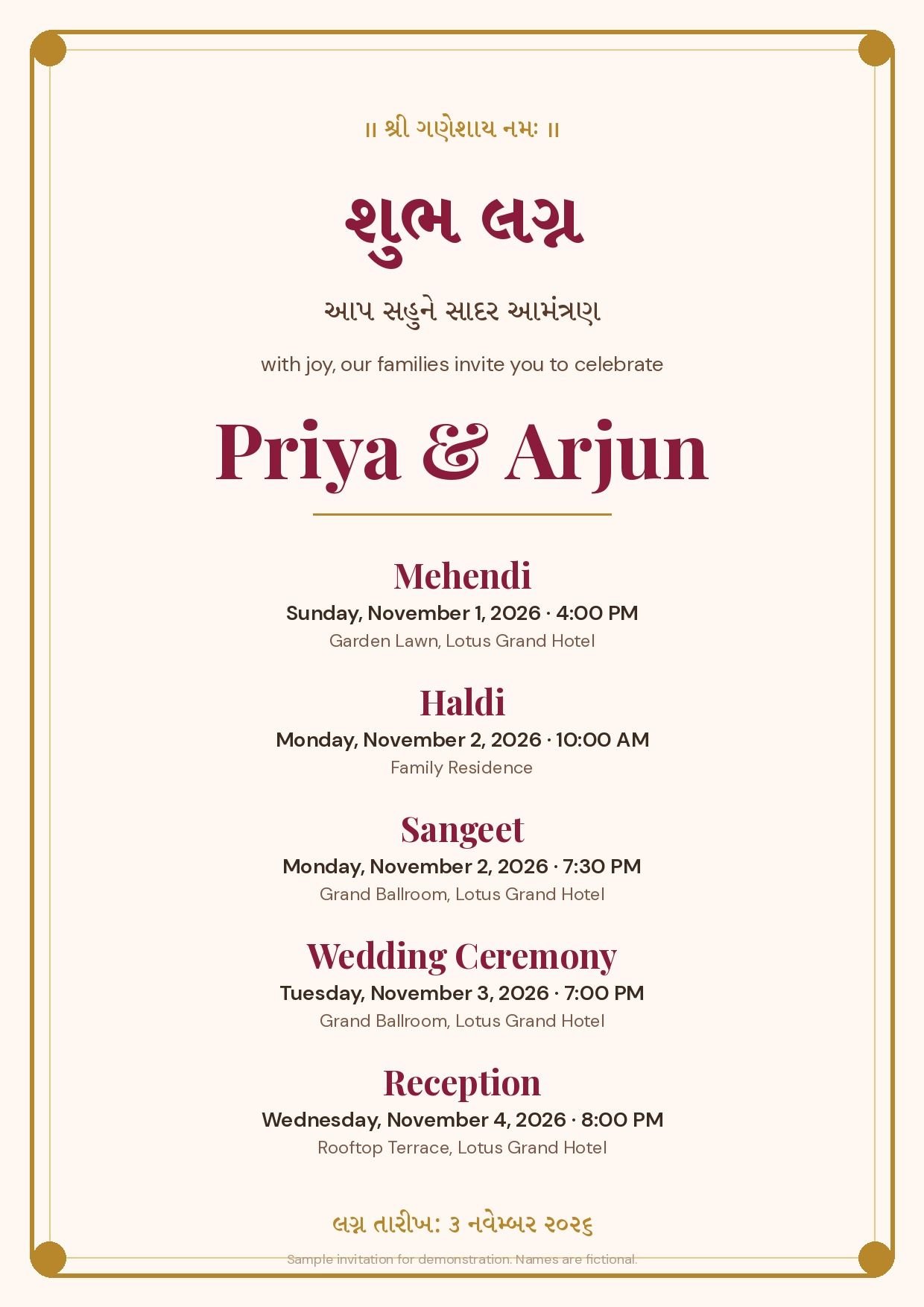
An Indian wedding is not one event. It is often several days of celebrations, each with its own time, place, dress and mood. If you have been invited to one, the invitation card might list five or more functions. This guide explains what each one is, how to plan for them, and how to keep all the dates straight.
Traditions vary widely by region, community and family. Treat this as a friendly overview, and when in doubt, ask the family.
Read the invitation carefully
Indian wedding cards often list every function with a date, a time and a venue. They may be written partly or entirely in a regional language, such as Gujarati, Hindi, Punjabi or Tamil, and sometimes give dates in the Hindu calendar as well as the English one.
Look for:
- Which functions you are invited to. Some cards include separate inserts for different events.
- Times and venues. Functions can be at different places: a family home, a garden, a hotel ballroom.
- Dress codes or colour themes. Some families choose a colour for each function.
- RSVP details. Reply early; families plan catering carefully.
A card with five functions means five dates to remember. Invited reads the whole card, in 80+ languages, and turns every function into its own reminder with the time and venue.
The main functions
Mehendi
At the Mehendi, intricate henna designs are applied to the bride’s hands and feet, and often to female guests too. It is usually relaxed and joyful, with music and snacks, and often takes place a day or two before the wedding. Wear something comfortable that you do not mind getting a little henna on, and allow time: designs take a while and need to dry.
Haldi
At the Haldi ceremony, a paste of turmeric is applied to the bride and groom, usually in separate ceremonies at their family homes, for blessings and a glow before the wedding. It is often in the morning and can be messy in the best way. Guests commonly wear yellow, and old clothes are a sensible choice.
Sangeet
The Sangeet is an evening of music and dance, where families perform, guests join in and everyone celebrates. It is one of the most festive nights. Party wear is the norm, and if the family has asked guests to prepare a dance, practise early.
The wedding ceremony
The ceremony itself varies by tradition. In many Hindu weddings, the couple takes seven steps or circles a sacred fire (the pheras), with rituals led by a priest. Ceremonies can be long, and the timing is often set by an auspicious moment (muhurat), which can mean an early morning or a late night. Arrive on time, dress formally and follow the family’s lead.
Reception
The reception is usually the most formal party, hosted after the wedding, often in the evening. It is a chance to congratulate the couple, share a meal and meet both families. Formal evening wear is typical.
Other functions you may see
Depending on the family, there may also be an engagement or ring ceremony, a Ganesh puja, a baraat (the groom’s procession with music and dancing), and a farewell for the bride (vidaai).
Planning as a guest
Keep a simple schedule
With several events over several days, write out a schedule with each function’s date, time, venue and dress. Add travel time between venues. Set reminders the day before each event (to plan clothes) and a few hours before (to leave on time).
Dates in the Hindu calendar
Some cards give a date as a tithi, such as “Kartik Sud 5”, from the Vikram Samvat calendar. Our free Vikram Samvat converter turns a tithi into an English date. Invited also understands Vikram Samvat and 8 other calendar systems.
Outfits
Many guests plan a different outfit for each function. Check the dress code early, especially if there is a colour theme, and allow time for tailoring.
Gifts
Customs vary: some families prefer cash in an envelope, others have a gift registry, and some ask for no gifts at all. If you are unsure, ask a close family member.
Travel and stay
For destination weddings or events in another city, book travel early, as wedding seasons are busy. Keep booking confirmations with your event schedule.
If you are travelling for the wedding
Destination weddings and weddings in another city add a layer of planning:
- Book early. Wedding seasons coincide with festivals and holidays, and flights and hotels fill up.
- Ask about room blocks. Families sometimes reserve rooms for guests at a group rate.
- Pack by function, with each outfit and its accessories together, so you are not searching a suitcase between events.
- Keep every booking with your schedule, so the flight, the hotel and the functions are all in one place.
A sample schedule
| Function | Date | Time | Venue | Dress |
|---|---|---|---|---|
| Mehendi | Sun, Nov 1 | 4:00 PM | Garden Lawn, Lotus Grand Hotel | Comfortable, colourful |
| Haldi | Mon, Nov 2 | 10:00 AM | Family residence | Yellow, old clothes |
| Sangeet | Mon, Nov 2 | 7:30 PM | Grand Ballroom | Party wear |
| Wedding Ceremony | Tue, Nov 3 | 7:00 PM | Grand Ballroom | Formal traditional |
| Reception | Wed, Nov 4 | 8:00 PM | Rooftop Terrace | Formal evening |
Enjoy it. Indian weddings are generous, joyful and full of people glad you came. With the dates handled, all you need to do is show up and celebrate.