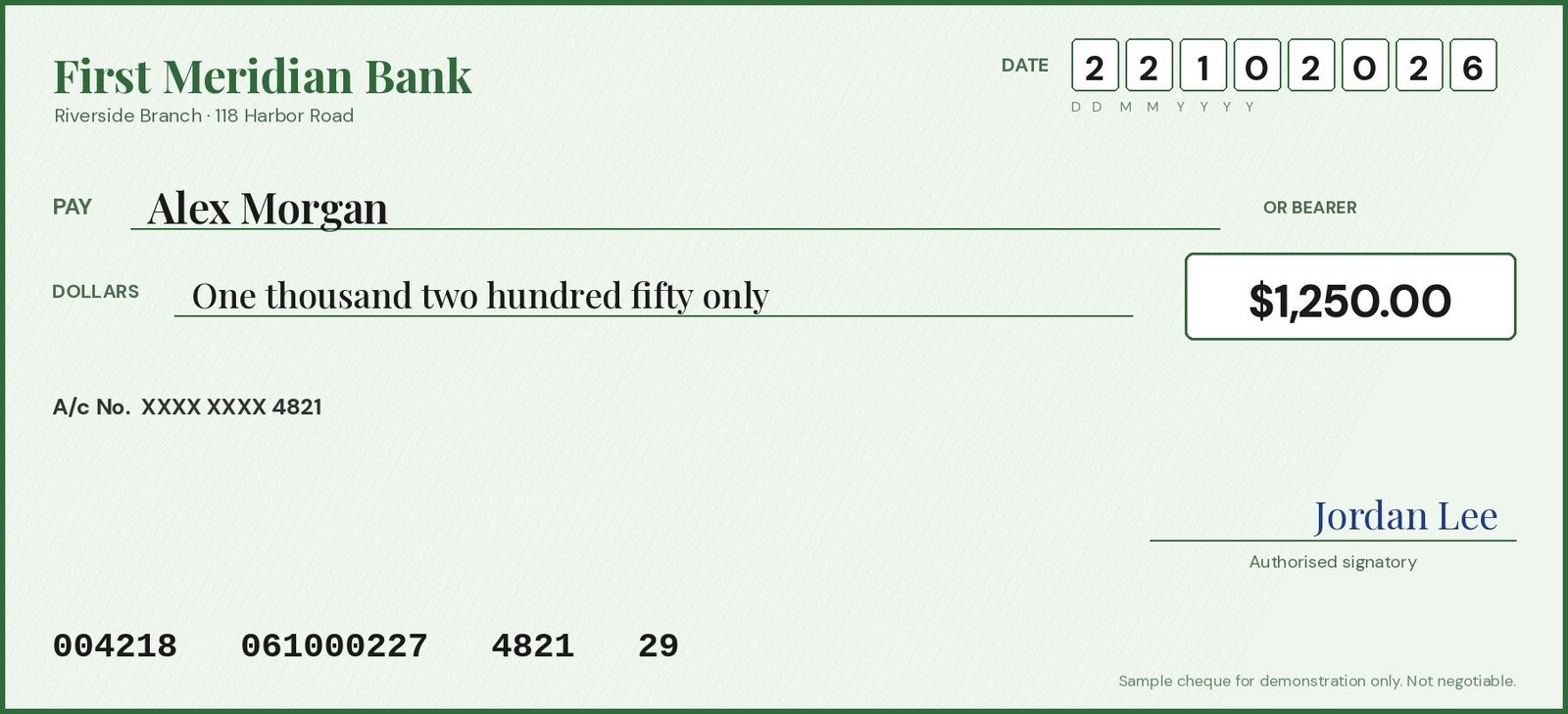
A cheque feels like money in hand, but it comes with an expiry date that is not printed anywhere on it. Leave it in a drawer too long and the bank can refuse to pay. Here is how long cheques stay valid, how to work out the exact last day, and how to make sure you never get caught out.
The short answer
How long a cheque is valid depends on the country, and the clock always starts on the date written on the cheque, not the day you received it.
| Country | Validity | Notes |
|---|---|---|
| India | 3 months | Reserve Bank of India rule since 1 April 2012 |
| United States | 6 months | Banks are not required to pay older cheques, but may |
| United Kingdom | 6 months | Common banking practice |
| Canada | 6 months | Cheques older than this are usually treated as stale-dated |
| Australia | 15 months | Cheques are generally considered stale after 15 months |
Banks can apply their own rules, and some cheques print their own limit, such as “void after 90 days”. If the cheque shows a limit, that one applies. When in doubt, ask your bank.
How to work out the last valid date
The simplest rule: count the months forward from the date on the cheque, then step back one day.
Example 1: India, a regular cheque
A cheque is dated 10 January 2026. Three months later is 10 April 2026, so the last day to present it is 9 April 2026.
Example 2: a month with fewer days
A cheque is dated 30 November 2026. Three months later would be “30 February”, which does not exist, so the count stops at the end of February: the last valid day is 27 February 2027.
Example 3: the United States
A cheque is dated 15 March 2026. Six months later is 15 September 2026, so after 14 September 2026 the bank is no longer obliged to pay it.
You can check any date with our free cheque validity calculator.
Post-dated cheques
A post-dated cheque carries a future date. You cannot deposit it before that date, and its validity period only begins on that date. If someone gives you a cheque dated three weeks from now, you have three weeks plus the full validity period.
The risk with post-dated cheques is forgetting them entirely: they sit in a wallet waiting for their date, and by the time you remember, the moment has passed. A reminder set for the cheque’s date solves this.
Why you should deposit early anyway
The last valid date is a limit, not a target. Depositing early has real advantages:
- Clearing takes time. A cheque deposited on its last valid day may be checked after that day.
- Weekends and holidays. If the last day falls on a holiday, you may effectively lose it.
- Bounced cheques. If a cheque is returned unpaid, you want time to contact the payer for a new one.
- Account changes. The payer’s account could be closed or run low as time passes.
A good habit is to deposit within a week of receiving a cheque.
What happens when a cheque expires
An expired, or “stale”, cheque is not automatically worthless, but most banks will not pay it. The money has not left the payer’s account, so the usual fix is simple: ask the payer to cancel the old cheque and write a new one. For business payments, send the old cheque back with your request so they have a clear record.
A system for cheques
If you receive cheques regularly, as a small business, a landlord or a freelancer, keep it simple:
- Photograph each cheque the day it arrives. This gives you a record of the date, amount and payer.
- Set a deposit reminder a few days after you receive it, or on the cheque’s date if it is post-dated.
- Deposit in batches once or twice a week.
Invited does steps 1 and 2 at once: take a photo of the cheque and it reads the date and the amount, then reminds you to deposit it. You review what it found before anything is saved.
Writing cheques: avoid surprises for others
If you write cheques, you can help the person receiving them:
- Date the cheque correctly and clearly. An unclear date can cause a cheque to be rejected.
- Keep a record of the cheque number, date, payee and amount.
- Check your statement. If a cheque has not been cashed after a few weeks, remind the payee before it goes out of date.
- Keep enough money in the account until the cheque clears, however long the payee takes to deposit it.
Key points
- Validity counts from the date written on the cheque.
- India: 3 months. US, UK, Canada: 6 months. Australia: 15 months. Banks may differ.
- Count the months forward, then step back one day.
- Deposit early; do not aim for the last day.