Missing a bill rarely happens because you cannot pay it. It happens because the date slipped past while you were busy. The fix is not more willpower; it is a simple system that puts every due date in front of you at the right moment. Here is one that takes about ten minutes to set up and a minute a week to run.
Why bills get missed
Bills arrive in too many places. The electricity bill comes on paper, the phone bill as an email PDF, the credit card statement inside a banking app, and rent is a date everyone “just remembers”. Each bill also has its own cycle: monthly, quarterly, yearly. Keeping all of that in your head is exactly the kind of job your head is bad at.
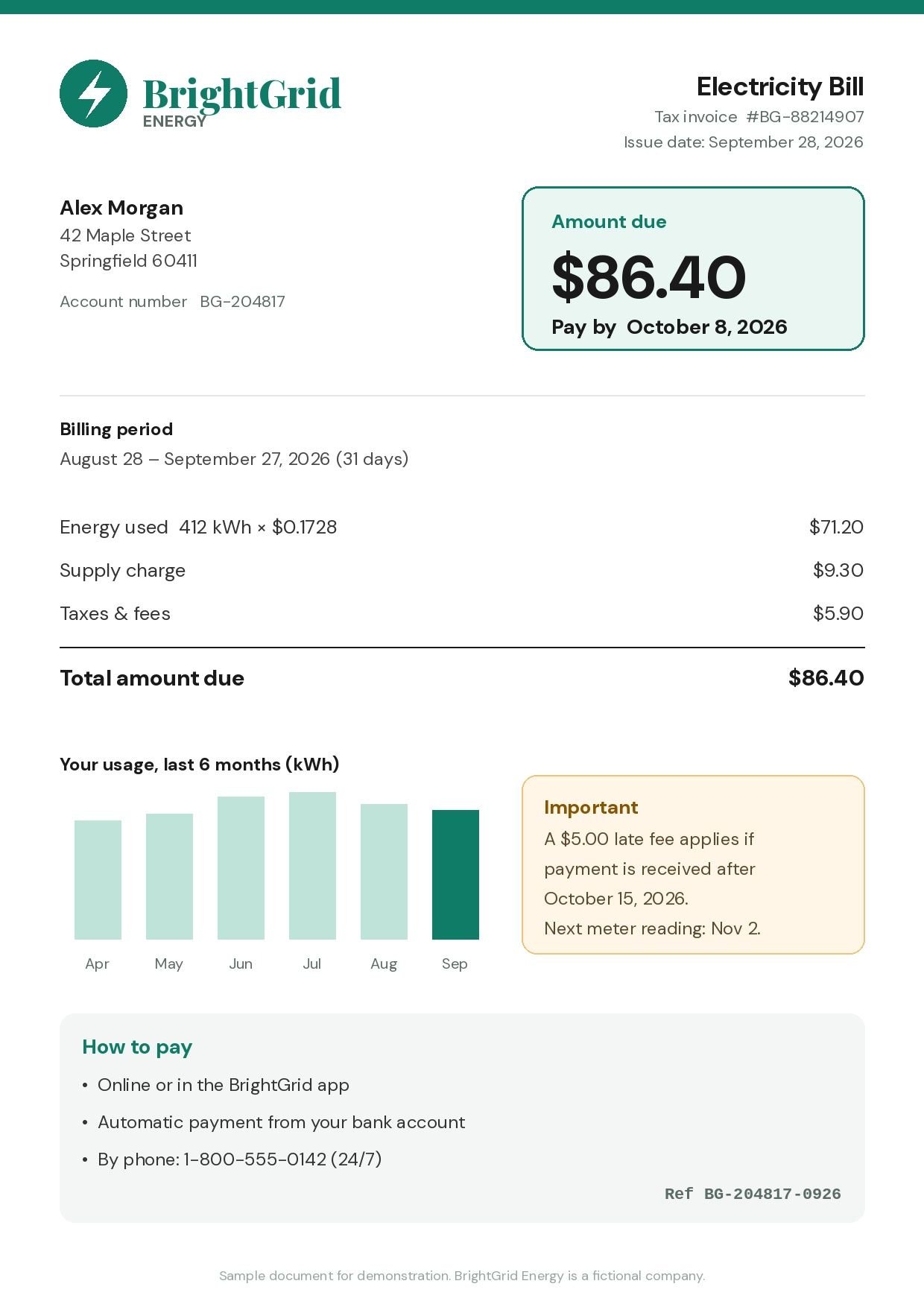
There is also the fine print. Many bills have two important dates:
- The due date, when payment is expected.
- The late-fee date, when a penalty starts. Many utilities add a late fee 5–15 days after the due date.
If you only remember one date, make it the due date. If you can remember both, a missed due date does not have to become a fee.
Step 1: Make a list of every bill
Sit down once with your bank statement from the last three months. Every regular payment you see is a bill you need to track. Write down:
| Bill | How it arrives | Cycle | Usual due day |
|---|---|---|---|
| Electricity | Paper | Monthly | ~8th |
| Mobile phone | Email PDF | Monthly | ~15th |
| Credit card | App | Monthly | ~22nd |
| Car insurance | Email PDF | Yearly | October |
Do not forget the yearly ones: insurance, subscriptions, memberships, licence renewals and property taxes. They are the easiest to miss because they only come round once.
Step 2: Decide how each bill gets paid
For each bill, choose one of three approaches:
- Autopay for fixed amounts, such as rent or a loan instalment. Set it up once and put a yearly reminder in your calendar to check it is still running.
- Pay on reminder for amounts that change, such as electricity, water or credit cards. You want to see the amount before it leaves your account.
- Decide on reminder for renewals, such as insurance or subscriptions, where the renewal is a chance to compare prices or cancel.
Step 3: Capture every date the moment the bill arrives
This is the step that makes the system work. The best time to record a due date is the moment you see the bill, not later. Build one habit: bill arrives, date captured, done.
You can do this by typing the date into a calendar, but it is slow, and slow habits do not last. A faster way is to photograph the bill with an app that reads dates for you. With Invited, you take a photo of a paper bill, or share the PDF from your email, and it finds the due date, the amount and the late-fee date, then creates a reminder for each. You check what it found, save, and the bill goes in the recycling.
Step 4: Choose reminder times that give you room
A reminder is only useful if it arrives with enough time to act.
- 2 days before for bills you pay by bank transfer, which can take a day or more to arrive.
- 24 hours before for card payments that post quickly.
- 1 hour before as a last call, never as your only reminder.
For bills with a late-fee date, a second reminder before that date is your safety net.
Step 5: A weekly two-minute check
Once a week, say Sunday evening, open your reminders and look at the next seven days. Is there enough money in the right account? Is anything unusual, like a bill much higher than normal? This small check catches problems while they are still easy to fix.
Step 6: Keep proof, then let go
After paying, keep the payment confirmation until the next bill shows it was received. Most billers show “previous payment received” on the next statement; once you see it, you can delete the old confirmation.
What to do if you miss one anyway
It happens. If you miss a due date:
- Pay as soon as you notice. Late fees often apply after a grace period, and some billers waive a first late fee if you call and ask politely.
- Check whether the payment was received. Sometimes a payment was sent but applied late.
- Look at why it slipped. Was the bill somewhere you did not look? Was the reminder too close to the deadline? Adjust the system rather than blaming yourself.
A simple system, summed up
- List every bill once.
- Decide: autopay, pay on reminder, or decide on reminder.
- Capture each date the moment the bill arrives.
- Set reminders with enough room to act, including late-fee dates.
- Check the week ahead every Sunday.
The whole point is to stop carrying dates in your head. Put them somewhere that will remind you, and your attention is free for everything else.