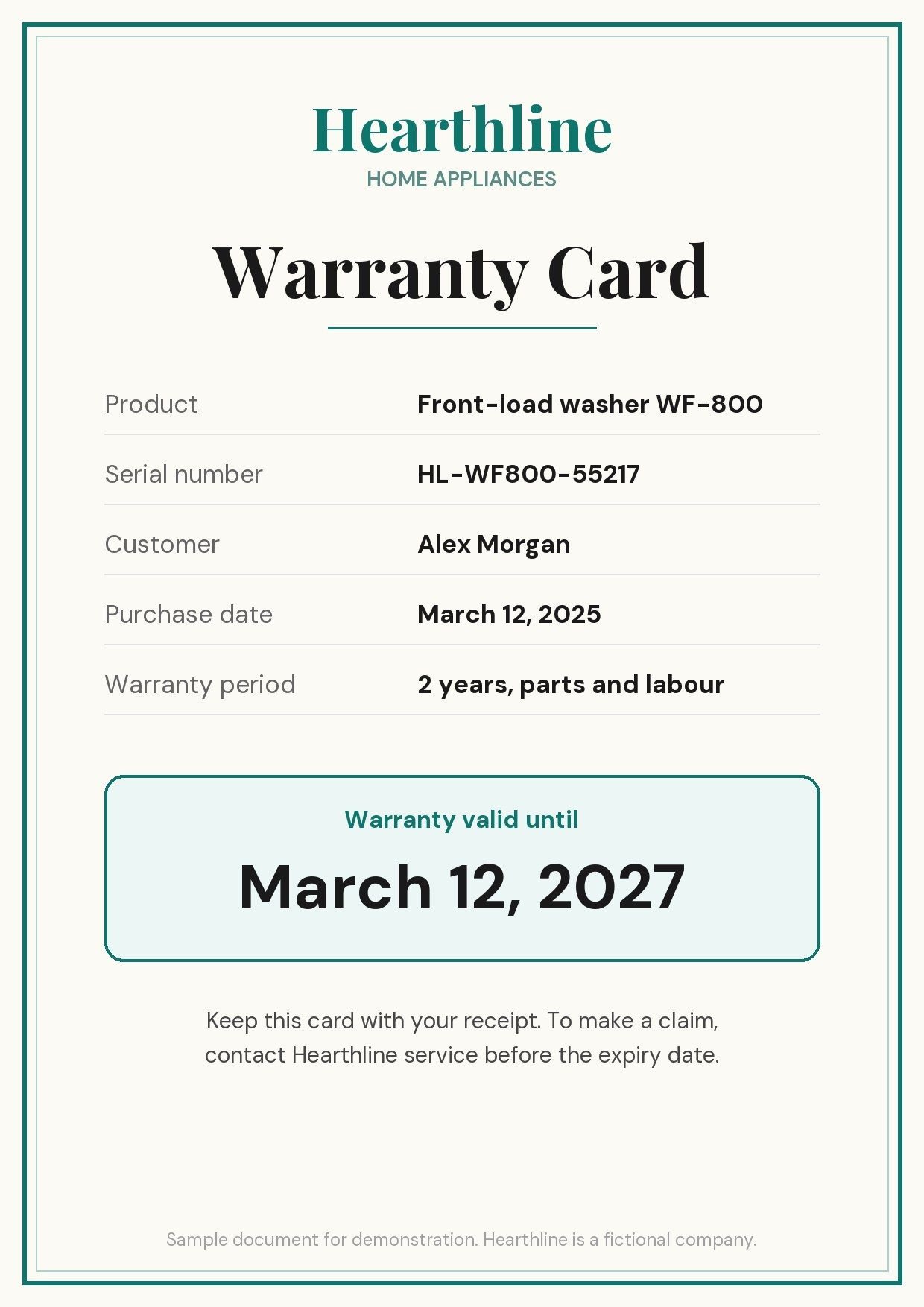
Warranties are valuable exactly when you have forgotten them. A washing machine that starts leaking in month 23 of a 24-month warranty is a free repair; in month 25 it is a bill. The trick is simple: know the expiry date, and check your things before it.
Why warranties get wasted
- The paperwork disappears. Warranty cards and receipts go into drawers, and thermal-paper receipts fade.
- Nobody knows the end date. Warranties run from the purchase date, which is rarely written down anywhere you would look.
- Small faults get ignored. A noisy fan or a weak battery seems too minor to claim for, until it fails after the warranty ends.
Step 1: Capture it on the day you buy
Build a habit for every purchase over a certain amount: say, anything that plugs in or costs more than a weekly grocery shop.
- Photograph the receipt or save the email confirmation.
- Photograph the warranty card, or note the warranty period from the box or the manufacturer’s website.
- Note the serial number, which is often needed for a claim.
- Set a reminder for the expiry date.
Invited handles steps 1 and 4 together: take a photo of the warranty card and it finds the expiry date and reminds you before it runs out. If the card only shows the purchase date, add the expiry as a manual reminder, which is free and unlimited.
Step 2: Register if it helps
Some manufacturers ask you to register the product. Registration is often optional for the basic warranty, but it can make claims faster and may be required for extended cover. If you register, keep the confirmation with your receipt photo.
Step 3: Keep one simple list
A short table is enough:
| Item | Bought | Warranty | Expires | Proof |
|---|---|---|---|---|
| Washing machine | 12 Mar 2025 | 2 years | 12 Mar 2027 | Photo of receipt |
| Laptop | 3 Jun 2025 | 1 year | 3 Jun 2026 | Email invoice |
| Headphones | 20 Nov 2025 | 1 year | 20 Nov 2026 | Photo of card |
Step 4: Do a “last month check”
The most useful reminder is not on the expiry date but a few weeks before it. When it arrives:
- Test the item properly. Run the washing machine on a full cycle, charge the laptop battery from empty, listen for odd noises.
- Look for cosmetic defects that are covered, like peeling finishes or loose parts.
- Claim now if anything is wrong. Claims are simpler while the warranty is clearly valid.
Set one reminder a month before and one a couple of days before. The first gives you time to test; the second is a last call.
Step 5: Know how to claim
When something goes wrong:
- Check what is covered. Most warranties cover manufacturing defects, not accidental damage or wear and tear.
- Gather your proof: receipt, serial number, and photos or video of the fault.
- Contact the seller or manufacturer through their official support channel.
- Keep a record of case numbers and dates of every conversation.
Extended warranties
Extended warranties and service plans can be worthwhile for expensive items that are costly to repair, but read what they cover and what they exclude. They have their own start and end dates; track them exactly like a normal warranty.
Your legal rights
Warranties sit on top of consumer law, not instead of it. In the European Union, for example, sellers must provide a legal guarantee of at least two years for goods. Rules vary by country, so if a seller refuses a fair claim, look up your local consumer rights.
What a warranty usually does not cover
Knowing the exclusions saves frustration. Most manufacturer warranties do not cover:
- Accidental damage, such as drops, spills and cracked screens, unless you bought extra cover.
- Normal wear and tear, like worn buttons or faded finishes.
- Consumables, such as filters, bulbs or batteries, unless the terms say otherwise.
- Damage from misuse or unauthorised repairs, which can void the warranty.
Read the warranty terms once, when you buy. It takes five minutes and tells you exactly what you can claim for.
A household warranty routine
Put all of this together and warranty tracking takes a couple of minutes per purchase:
- At purchase: photograph the receipt and warranty card; set expiry reminders.
- A month before expiry: test the item and claim if anything is wrong.
- At expiry: decide whether an extended plan is worth it for this item, and archive the paperwork.
Summary
- Photograph the receipt and warranty card on the day you buy.
- Record the expiry date and set reminders a month and a couple of days before.
- Test your things before the warranty ends and claim early.
- Keep proof of purchase; you will almost always need it.